Unidentified Ngata or Mongo artists, Democratic Republic of Congo
First half of 20th century
Brass
Diam. 19.3 - 25.4 cm; Weight 2.3 - 8.7 kg
Diam. 7.6 to 10 in.; Weight 5.16 lbs. to 19.15 lbs.
A Set of Eighteen Ngata or Mongo Neck Rings
A late nineteenth-century photograph, taken in west-central Congo, shows a woman wearing a heavy brass neck ring like these. She is identified as a Ngata woman, belonging to a small ethnic group along the Congo River that is part of the large Mongo conglomerate. The image was published in the guide to the Congo Free State section of the 1897 World Exhibition in Brussels and Tervuren (Belgium). Reflecting the spirit of the age, the author pitied “those poor things” who were condemned to wear such “crushing load” (Masui 1897: 99). The weights of the specimens here range from 2.3 to 8.7 kg, but heavier examples exist. Clearly, these ornaments were worn by members of local elites
The neck rings had to be fitted by a blacksmith, who pounded the opening shut with the wearer lying on the floor, one end of the neck ring resting on an anvil. The literature is inconsistent about the permanency of this type of embellishment. Some sources mention that the women had to wear the neck rings “their whole lives” (Masui 1897: 99), but this does not seem to have been the case. To get a neck ring off, a metal wedge was pounded into the opening to force the ends apart.
The Ngata extracted iron, which they traded for copper and brass that came from mining areas close to the Atlantic Coast. While these metals were primarily cast into bars that circulated throughout the Congo Basin as currency, along the way people would cut off pieces or use entire bars as raw material for ornaments. The colors of the neck rings in this set vary, depending on their content of copper. Most display a beautifully ribbed surface, while all have been engraved at the extremities. One striking motif that appears on most of the neck rings is an eye-shaped depression. We do not know if it had a symbolic meaning or protective function.
Mark’s Notes:
I collected over 40 of these collars, in total. This group includes the best ones, including an 18 lb. specimen (the brassy one) and a 19 lb. specimen (the pale greenish one). The brassy one is a true museum piece. I could barely believe my eyes when it arrived from a British auction house.
Literature:
. Ballarini, Roberto. 2009. The Perfect Form: On the Track of African Tribal Currency. Milan: Galleria Africa Curio.
. Herbert, Eugenia. 1984. Red Gold of Africa: Copper in Precolonial History and Culture. Madison: The University of Wisconsin Press.
. Masui, Théodore. 1897. Guide de la section de l’État indépendant du Congo à l’Exposition de Bruxelles-Tervueren en 1897. Brussels: Imprimerie Veuve Monnom.
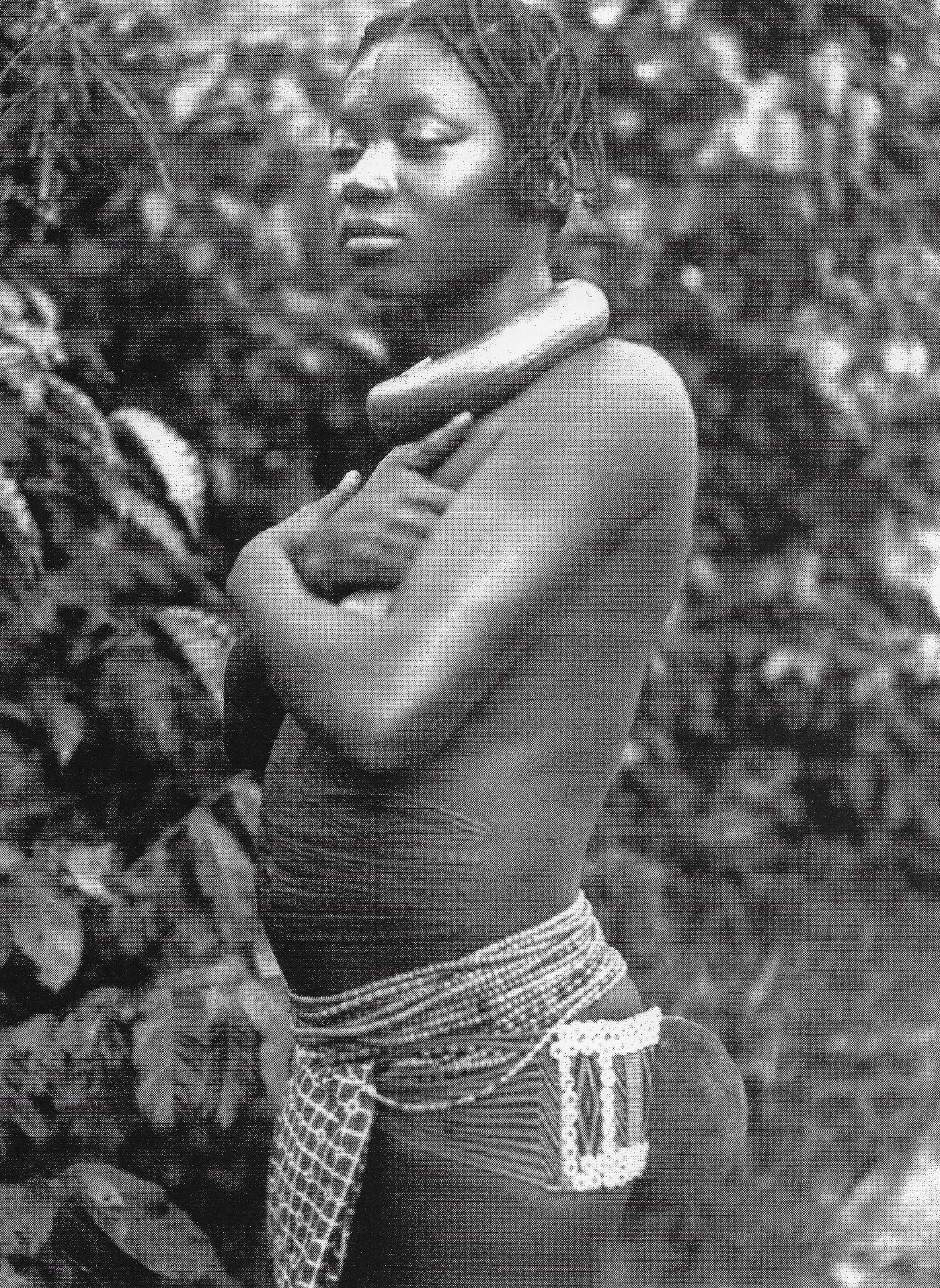
Ngata woman wearing a brass neck ring. Democratic Republic of Congo. Photo 1910-1930 © Missionaries of the Sacred Heart, Borgerhout (Belgium)
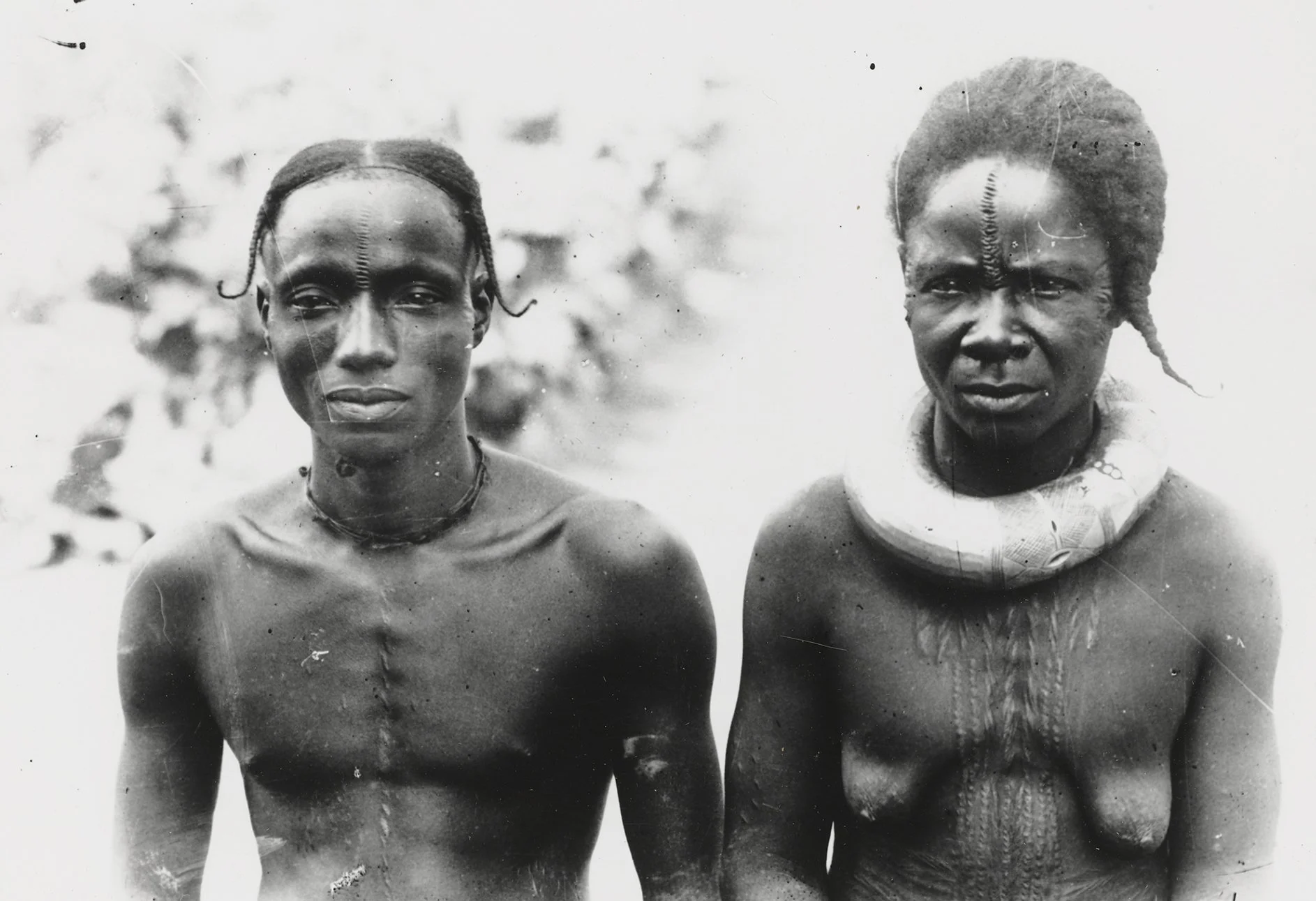
Ngata woman wearing a brass neck ring. Around Mbandaka, Democratic Republic of Congo. AP.0.0.275, collection RMCA Tervuren. Photo: François Léopold Michel, 1896