A Set of eight Topoke or Lokele Currency Blades
Unidentified Topoke or Lokele artists, Democratic Republic of Congo
First half of 20th century
Iron
H. 141 to 166 cm; Weight 0.6 – 1.7 kg
H. 55.5 to 65.3 in.; Weight 1.35 lbs. to 3.82 lbs.
In some African languages, the word for “iron” also means “a thing of value” or, more specifically, “money.” All over the continent, blacksmiths made metal currency for many hundreds of years before colonial authorities imposed the institution of minted coinage from the late nineteenth century onward. The currency might come simply in the form of ingots or crosses of iron, but also in a variety of forms modeled on functional objects, like hand tools or weapons. Among the most spectacular examples are the enormous blades used by the Topoke, Lokele, and neighboring peoples of the Democratic Republic of Congo. Representing wealth and authority, they look like spearheads, but their makers did not use them as weapons. They served in important exchanges, including land deals, payments of ritual fines, purchases of canoes, and marriage compensations offered to the family of the bride. The Belgians banned their usage in the early 1920s, as all Congolese people were obliged to earn colonial francs to pay taxes.
In general, the blades range from 140 cm to 200 cm, taller than a person. These examples fall in the 141 - 166 cm range. The blades are known by several names—including liganda, dihunga, and doa—depending on their size and their origin. The greatest number of blades come from the Topoke and Lokele peoples, yet neighboring Hanga, Olombo, and Turumbu smiths welded this type of currency too, each having their own terminology. Most old specimens show parallel incisions along the left edge of each face, creating a subtle asymmetry. The blades end in a hollow, cylindrical extension that either held a wooden pole or was stuck directly into the ground. One of the blades here appears to have been painted, and an example with red and white pigments is known from the literature. The meaning of the colors is not known, however.
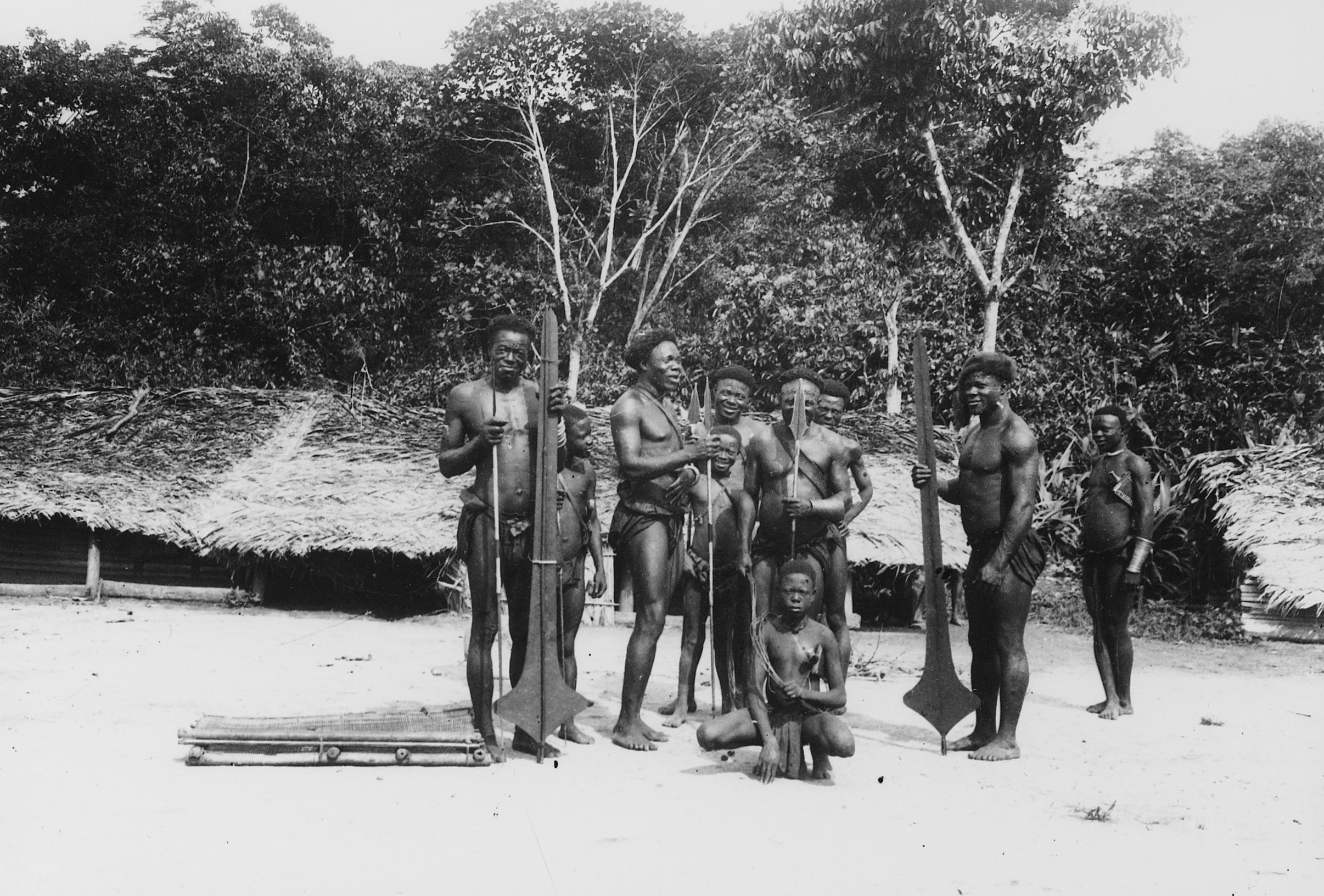
Topoke men holding conventional spears (in the middle) and two currency spear blades (left and right). South of Kisangani, Democratic Republic of Congo. EP.0.0.11715, collection RMCA Tervuren; photo probably Ernest-Victor Thévoz, 1901
Mark’s Notes:
I bought these eight specimens (along with another two that turned out to be partially bent in their mid-sections) at the African Marketplace in Tucson, Arizona back in the early 2000s. Multiple 50-piece bundles of these large currency blades had just arrived at a seller’s tent, and he had not even unwrapped them yet. There were literally hundreds and hundreds of these blades. I asked the seller if I could cut some of the plastic bindings and pick out a few pieces to purchase, and he gave his permission. It is not uncommon for an ethnographic object-type to have been cleaned-out of a particular locale en masse. I have witnessed other such hordes for sale at the African Marketplace, including very tall stacks of monumental Afo hoe currencies, tables full of bronze bracelets, huge piles of Mbole brass anklets, and scores of Ashanti wood stools. They were a potent reminder that many of these objects were made in great quantities.
Literature:
. Ballarini, Roberto. 2009. The Perfect Form: On the Track of African Tribal Currency. Milan: Galleria Africa Curio.
. Roberts, Allen. 2019. “Precolonial Currencies: Value, Power, and Prestige,” pp. 150-163 in Allen Roberts, Tom Joyce, and Marla Berns, eds. Striking Iron: The Art of African Blacksmiths. Los Angeles: Fowler Museum at UCLA.